




They are not experimental spaces separated from reality, but real-life contexts where complexity is embraced as a resource for innovation, inclusion, and shared prosperity.
Living Labs are not fixed structures, but adaptive processes.
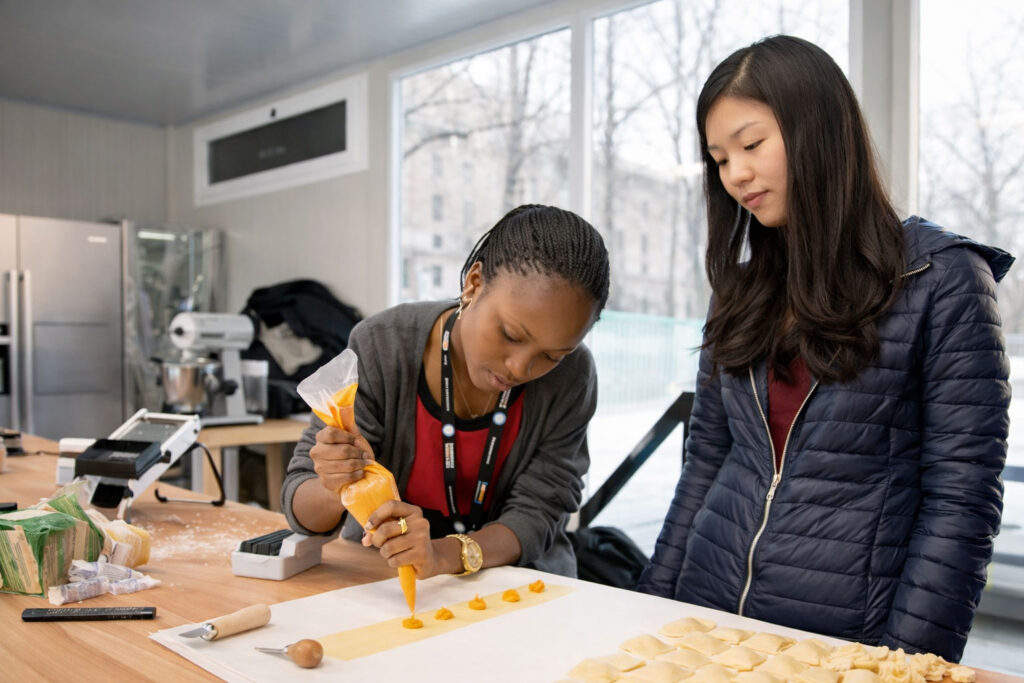
They function as open and evolving ecosystems where institutions, communities, researchers, students and practitioners collaborate to observe, test and co-create solutions to real-world challenges.
This approach enables learning to happen within complexity, not outside it, fostering systems thinking, critical awareness and long-term vision.
MEGALOPOLIS | KYOBASHI, TOKYO
MEDIUM-SIZED CITY | OFFICUCINA, REGGIO EMILIA
RURAL AREA | PAIDEIA, POLLICA
MEDIUM-SIZED CITY | SCUDERIA, BOLOGNA
RURAL AREA | VILLA MONTEPALDI, SAN CASCIANO
Food becomes a lens through which to understand health, environment, culture and economies; territories become classrooms; communities become co-educators.
By working directly within places, Living Labs reconnect knowledge with context, and theory with practice.
They explore regenerative models that integrate environmental care, social inclusion and cultural value, enabling collective responses to global challenges.
Through shared experimentation, Living Labs activate responsibility, collaboration and the capacity to imagine alternative futures.
For Sara Roversi, Living Labs represent a fundamental methodology for cultural and systemic change.
They embody a way of working that transforms territories into learning ecosystems, capable of generating new models of leadership, governance, and responsibility.
Living Labs are where vision meets practice, and where future-ready communities begin to take shape.
Rispettiamo la tua privacy
I cookie ci aiutano a migliorare la tua esperienza, fornire contenuti personalizzati e analizzare il traffico.
Clicca su Accetta per acconsentire o su Rifiuta per rifiutare i cookie non essenziali.